
Los Gatos · Sub-Zero sealed system & compressor
Is my Sub-Zero’s sealed system or compressor failing — or is it something cheaper?
If a built-in Sub-Zero in Los Gatos is running long, climbing in temperature, or throwing a control board, thermistor or display alarm, the sealed system and compressor are only one of several suspects. A stalled fan, a frosted evaporator or a failed sensor produce the same complaints far more often — and far more cheaply. We are a Sub-Zero-focused service: we read temperatures, watch run time and confirm the frost pattern before anyone mentions refrigerant. We diagnose across Los Gatos and route same-day requests through nearby Campbell, with EPA Section 608-regulated handling discussed only after evidence supports it.
Does my Sub-Zero really need a compressor, or something cheaper, in Los Gatos?
For a Glen Una estate in Los Gatos 95030, Los Gatos Sub-Zero Repair never names the sealed system from a symptom: we rule out condenser airflow, fans, sensors and controls, then take pressure readings before any $945-$2,650 compressor or refrigerant verdict. A low charge mimics a weak compressor. Want it proven first? Reach (408) 402-4604.
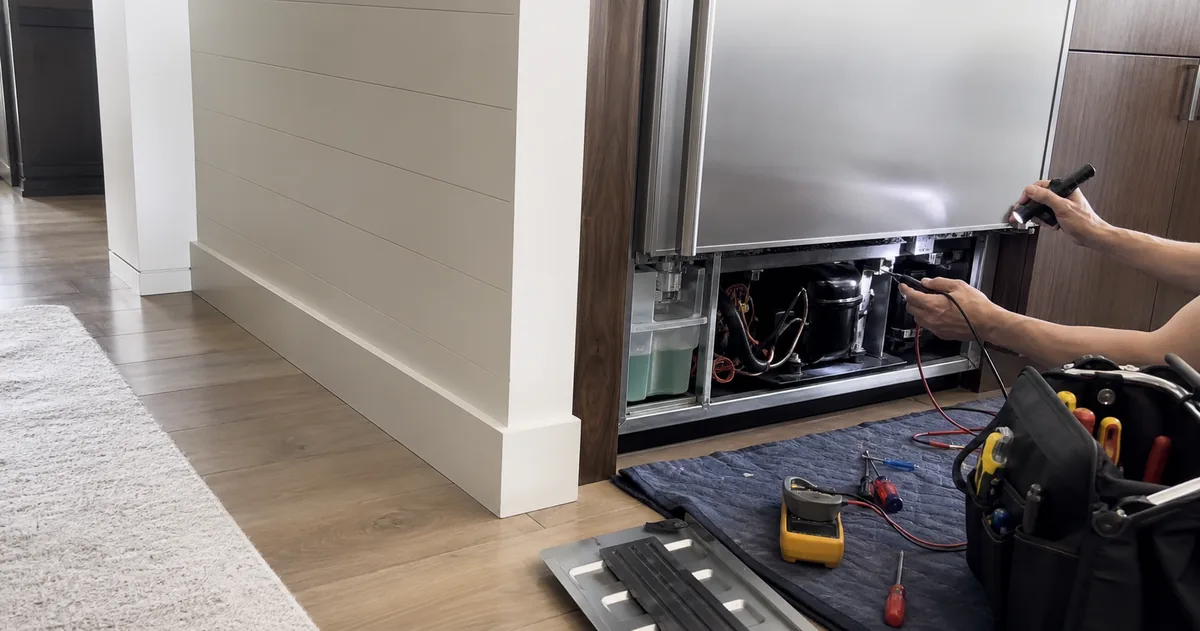
What a sealed-system split actually looks like on the meter
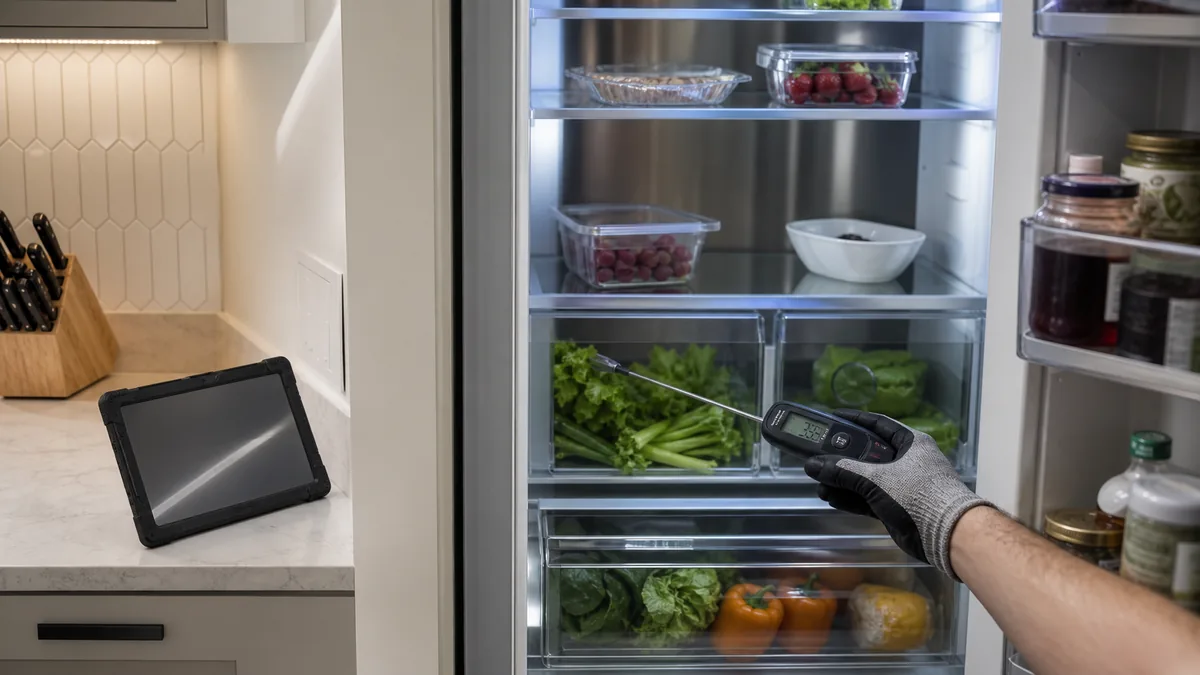
In plain language
“Fresh-food section warm while the freezer still holds”
This is one of the most misread Sub-Zero symptoms. On a dual-refrigeration built-in, the fresh-food compartment and the freezer each have their own sealed system — their own evaporator, their own metering, and on most designs their own way of moving cold air. That independence is exactly why one side can drift warm while the other stays rock-solid frozen. If the compressor or the whole sealed system had failed, you would normally see both zones lose temperature together, not one alone.
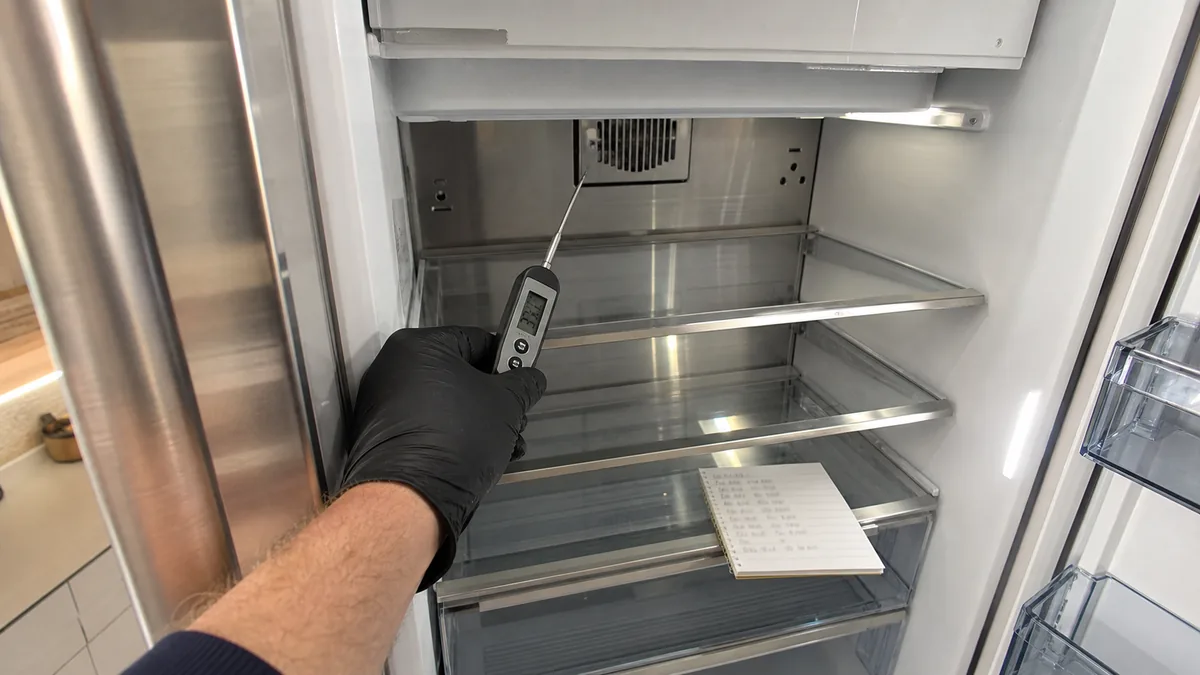
So when the fresh-food section is warm while the freezer still holds, the cause is usually local to that one zone: a stalled fresh-food evaporator fan that has stopped moving cold air, a coil quietly frosted behind the rear panel, a sticking air damper, or that zone’s thermistor or control reporting the wrong thing. What confirms it is measurement, not a guess — actual probe temperatures in each compartment, a look at the frost pattern behind the panel, and the unit’s run time. Those three readings together separate a cheap local fault from a true sealed-system problem.
One honest limitation: we cannot tell you which of those it is from a description alone. The same warm-fresh-food complaint can come from a fan, a damper, a sensor, a defrost fault or a leak, and only on-site instruments confirm the difference. We won’t quote sealed-system work — the expensive path — until the cheaper causes are measured out.
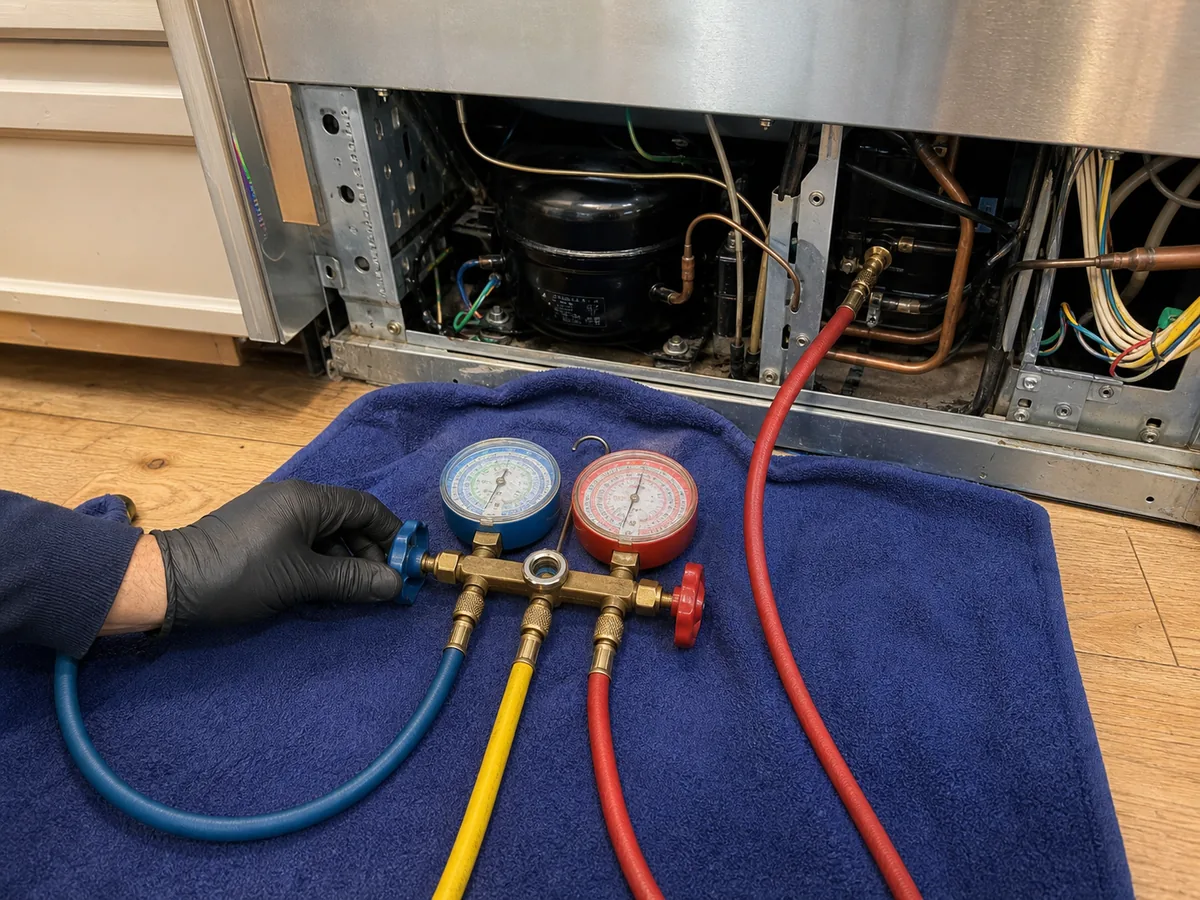
Read this before you touch refrigerant
Refrigerant and compressor work is not a homeowner DIY
Sealed-system work requires EPA Section 608-regulated handling and trained tools. Recovering, evacuating and recharging refrigerant is regulated under EPA Section 608 and requires qualified recovery equipment — venting refrigerant is unlawful, and an improperly brazed or contaminated loop fails again fast. Compressor replacement, leak repair, drier changes and cap-tube work all involve brazing, deep vacuum and metered charging. None of it is a homeowner task, and none of it is a “top-off and hope.”
Here is the honest split of what is and isn’t safe to do yourself:
What a homeowner CAN safely observe
- Run time
- Is the compressor running almost continuously, or cycling normally? Note roughly how long it runs.
- Frost pattern
- Through the interior, is the back wall evenly frosted, partly frosted, or iced over in patches?
- Temperatures
- A simple thermometer reading in each compartment, compared against the set point.
- Condenser airflow
- Whether the grille and visible condenser area are choked with dust or pet hair.
What a homeowner should NOT attempt
- Refrigerant
- Never open, tap, recover or recharge the sealed loop. It requires legally qualified refrigerant handling, full stop.
- Brazing / compressor
- No torch work, compressor swaps, drier or cap-tube changes.
- Pressure testing
- No gauges on the access ports; improper handling contaminates the system.
- Repeated resets
- Don’t keep clearing a control-board or display alarm — you erase the fault history we need.
How we separate the suspects
Sealed-system vs. everything-that-looks-like-it
Most of these symptoms overlap, which is why a symptom alone never justifies sealed-system work. Each row pairs the confirmation test with the false positive that traps DIY guesses. Values vary by model — we verify, never assume.
| Symptom | Possible component | Confirmation test | False positive to avoid | Repair path |
|---|---|---|---|---|
| Both zones slowly warming, compressor runs near-constantly | Refrigerant leak in the sealed loop | Frost-line read on evaporator, run-time observation, instrument check under recovery | Don’t blame the compressor — a low charge mimics a weak compressor | Qualified recovery planning, leak repair, drier & recharge |
| Compressor hums, clicks, won’t start or trips | Compressor or its start device (relay/overload/capacitor) | Electrical check of the start components before condemning the compressor | A failed start relay looks like a dead compressor; don’t replace the compressor first | Replace start device if faulty; sealed-system compressor swap only if confirmed |
| Long run times, warm overall, unit hot to the side | Condenser fan or blocked condenser airflow | Verify fan spins, inspect condenser for dust/pet-hair packing | Dirty-condenser heat looks like a sealed-system failure | Clean condenser, replace condenser fan if seized |
| One zone warm, the other holds; weak interior airflow | Evaporator fan in the affected zone | Confirm fan operation and even cold-air delivery behind the panel | A stalled evaporator fan mimics a sealed-system loss in that zone | OEM evaporator fan, verify defrost and damper |
| Gradual warming, heavy or patchy frost on the back wall | Cap-tube / drier restriction (metering blockage) | Frost-pattern read and temperature split across the metering point | A restriction can read like a low charge; don’t recharge blindly | Clear/replace drier and metering under recovery |
| Frost builds, then thaws and re-freezes in cycles | Defrost circuit (heater, sensor or timer) | Observe defrost cycle, check defrost sensor and heater continuity | A defrost fault frosts the coil and looks like a sealed-system issue | Replace defrost component; no refrigerant work needed |
| Display alarm or wrong temperature reported, mechanicals seem fine | Thermistor / sensor or control board | Compare sensor reading to actual probe temperature; check board outputs | A drifting thermistor reads “warm” when the box is actually fine | Replace thermistor or control board, serial-matched |
| Ice maker slow, jammed or producing hollow cubes alongside warming | Control or water-side fault, not always sealed system | Measure fill volume and cycle; confirm zone temperature separately | Don’t read poor ice as a compressor failure — it’s usually water or control | Address inlet valve/line or control; sealed-system only if proven |
Why the family matters
How sealed-system behavior differs across Sub-Zero families
The same complaint diagnoses differently depending on whether the unit runs one sealed system or two, and how it’s built. Exact specifications, charge weights and metering details must be verified by model and serial — we never quote them from memory.
- Dual-refrigeration built-in columns & side-by-sidesTwo independent sealed systems mean one zone can fail in isolation. A warm fresh-food side with a frozen freezer points local, not whole-unit — verify by model/serial which compressor serves which zone.
- Single-refrigeration designer & integrated unitsOne shared sealed loop, so a leak or compressor fault takes the whole box down together. There is no “split” clue here — confirmation leans harder on run time and frost pattern.
- Classic series built-insOlder deeply-built-in designs; serial age drives whether the correct OEM compressor, drier or control is still stocked or must be ordered. Metering and start devices vary across production years — verify by serial.
- Designer series columnsSlimmer evaporator and airflow paths make frost and fan faults easy to mistake for sealed-system loss. The diagnosis weights evaporator-fan and damper checks before refrigerant.
- Under-counter drawers & compact unitsUsually single-system with tight condenser airflow; airflow and condenser-fan faults dominate, and sealed-system access differs from full-height columns. Verify the configuration by model/serial.
- Wine storage columns (dual-zone)Two set points off one or two sealed paths depending on the model; a few degrees of drift over weeks usually reflects airflow, evaporator fan or sensor — confirm the exact loop layout by serial before any sealed-system call.
Evidence, not adjectives
When the ice maker is slow, jammed or making hollow cubes
Poor ice gets blamed on the compressor more than almost anything, and it’s almost always wrong. When a Sub-Zero ice maker is slow, jammed, or producing hollow cubes, the first evidence we gather is water-side and thermal — not a refrigerant gauge. Hollow or slow cubes usually trace to water volume: a partly-closed household shutoff, a weak inlet valve, or a fill tube starting to ice over. A jam is mechanical. None of those are sealed-system faults, and confirming them keeps you from paying for the expensive path you don’t need.
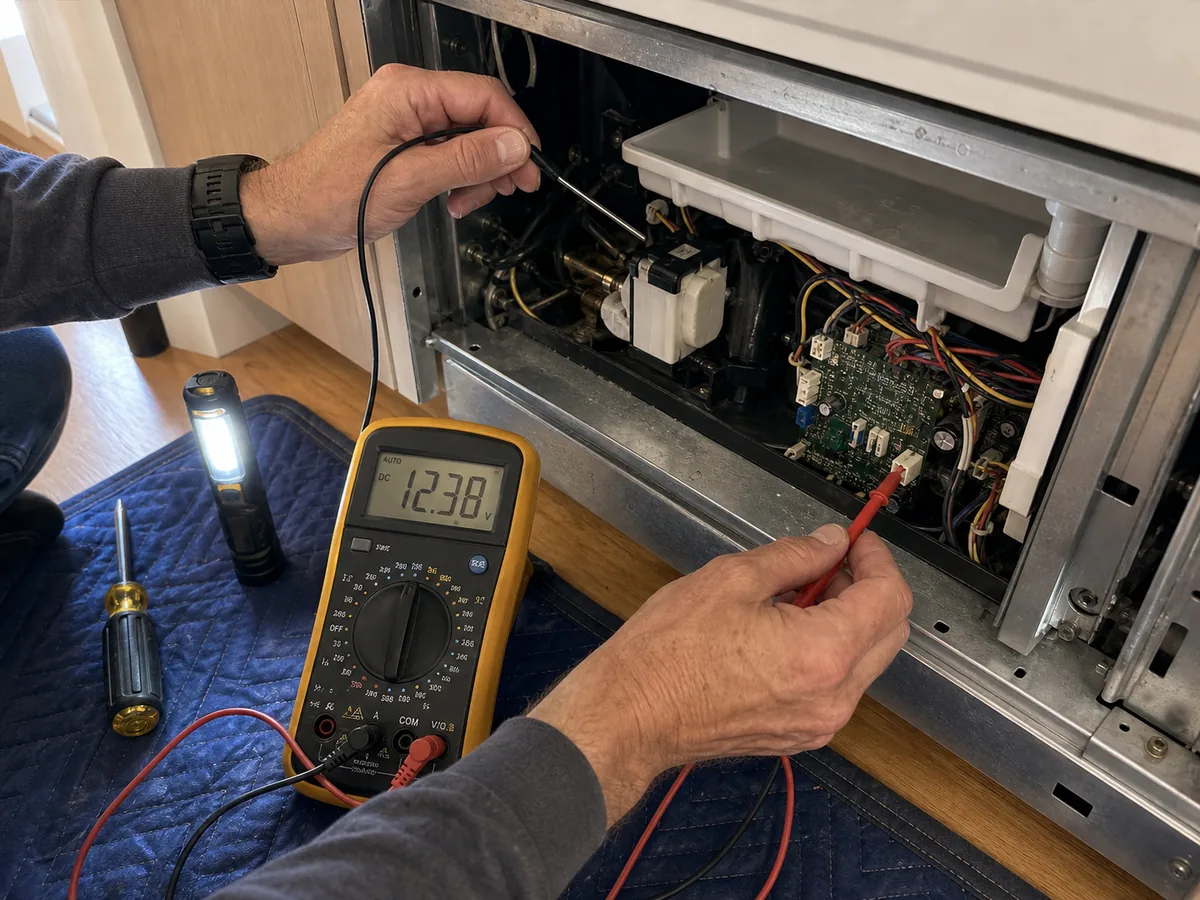
The proof we leave on the job is the same every time: logged temperature readings in each compartment against set point, condenser and evaporator photos showing airflow and frost condition, model-tag proof tying the unit to the right parts, and the OEM fan, gasket or control-board evidence — the actual failed part shown against the meter before we quote. That record is how we separate an ice or control issue, a fan, or a true sealed-system loss, instead of guessing. If the cause genuinely is the sealed system or compressor, you’ll see why on the readings, not just hear it asserted.
Why the route and the home age matter
Sealed-system requests in San Jose (Cambrian Park)
Cambrian Park sits just over the Los Gatos line in San Jose, and we route there the same day. The housing stock is largely mid-century ranch and 1960s–70s tract homes, which matters for sealed-system work in two concrete ways. First, many kitchens have an older built-in Sub-Zero set into original cabinetry with limited side clearance, so we plan how the unit comes out before we arrive rather than discovering it in your kitchen. Second, in homes of that age the unit itself is often old enough that the sealed-system question is really a repair-vs-replace question — serial age decides whether the correct OEM compressor, drier or control board is still stocked or has to be ordered. We confirm access and parts availability up front so a Cambrian Park visit fixes it on the first trip wherever the parts allow.
We also serve Los Gatos itself — including ZIP 95030, where many downtown and Almond Grove kitchens have deeply built-in columns that need the unit pulled and reseated true before the door seals after sealed-system service. We route the same day through Saratoga, Monte Sereno and Campbell. Book Online→
Repair or replace?
When sealed-system repair is still the smart money
Sealed-system and compressor repair is the most expensive thing we do, so it deserves the most honest math. A replacement built-in column or side-by-side runs many thousands of dollars installed once the cabinetry is refitted to the new unit. Against that, repairing the sealed system on a well-built 15-to-20-year Sub-Zero often extends it several more years at a fraction of replacement cost. But it isn’t automatic — on a much older or twice-repaired unit, replacement can win. We weigh the actual numbers with you on our repair-vs-replace page before you approve anything, and we never publish a fake precise price; the quote is confirmed in writing after diagnosis.
How can I tell if my Sub-Zero needs a compressor or just a cheaper repair?
You usually cannot from the symptom alone - a slow, both-zone warm-up can be a dusty condenser, a failed condenser fan or a sealed-system leak. We rule out airflow, fans, sensors and controls on instruments first; many calls resolve at $365-$695. Only a pressure-proven sealed-system fault is quoted at $945-$2,650.
How do I know if it’s the sealed system or just a fan or control?
You usually can’t tell from symptoms alone. A warm compartment, long run times and a control board, thermistor or display alarm can all come from a stalled fan, a frosted evaporator, a failed sensor or a leak. We confirm the difference with probe temperatures, run-time observation and a frost-pattern read before anyone mentions refrigerant — and we rule out the cheaper causes first.
Can a homeowner add refrigerant or replace the compressor?
No. Recovering and recharging refrigerant is regulated under EPA Section 608 and requires qualified recovery equipment, and compressor or sealed-system repair needs brazing, deep vacuum and trained tooling. It is not a DIY job. What you can safely observe and report is run time, the frost pattern on the back wall, and the temperature in each compartment.
Why is my fresh-food section warm while the freezer still holds?
On a dual-refrigeration Sub-Zero each compartment has its own sealed system, so the freezer can stay cold while the fresh-food side drifts. That split usually points to the fresh-food evaporator fan, a frosted coil, a damper or that zone’s control rather than a whole-unit compressor failure. We verify with probe readings and a look behind the rear panel before quoting sealed-system work.
Does sealed-system behavior differ between Sub-Zero models?
Yes. Dual-refrigeration built-ins run two independent sealed systems; many single-system designer and under-counter units share one loop, so a single fault affects everything. Classic, designer, column and side-by-side families differ in compressor placement, metering and controls. Exact specifications are verified by model and serial.
Is sealed-system repair worth it on an older Sub-Zero?
Often, yes, because a replacement built-in runs many thousands installed once cabinetry is refitted. A sealed-system repair can extend a well-built 15-to-20-year unit at a fraction of that cost. When a much older unit no longer makes financial sense, we say so plainly and point you to the repair-vs-replace math.
More reading: Home · Sub-Zero Repair · Not-cooling diagnostic · Book Online.
How we prove it
How we prove a Sub-Zero sealed-system fault in Los Gatos
- Read both zones. Establish whether one or both compartments are warming.
- Clear airflow. Clean the condenser and check the condenser fan — the cheap cause we rule out first.
- Test fans and controls. Meter evaporator fans, sensors and the control board before any refrigerant talk.
- Read pressures. Only after the above do we take sealed-system pressure and electrical evidence.
- Plan recovery. If a leak or compressor fault is proven, refrigerant is recovered under EPA Section 608.
- Quote with proof. Sealed-system work is $945-$2,650, shown against a $9,500-$16,500 replacement.
Cost of sealed-system work
Sub-Zero sealed-system & compressor cost in Los Gatos
Typical Los Gatos ranges for the expensive sealed-system exception, quoted only after cheaper causes are ruled out on instruments and confirmed in writing.
| Service / symptom | What’s included | Price range | Typical time |
|---|---|---|---|
| Diagnostic visit (credited) | Airflow / fan / control ruled out, pressure check | $135-$210 | 45-90 min |
| Cheaper false-positive repair (fan / condenser) | Condenser cleaned, fan motor | $365-$695 | 1-2 hrs |
| Sealed-system leak repair | Leak found, EPA-608 recovery, recharge | $945-$2,650 | 2-6 hrs + parts |
| Compressor replacement (built-in) | OEM compressor, recovery, evacuate / charge | $945-$2,650 | half-day + parts |
| Replacement context | New built-in column installed with cabinet refit | $9,500-$16,500 | project |
Fast fact: Sealed-system or compressor work is the expensive exception on a built-in Sub-Zero in Los Gatos: $945-$2,650, quoted only after airflow, fans, sensors and controls are ruled out. It is still far below a $9,500-$16,500 built-in replacement.
Customer reviews
What Los Gatos homeowners value after a Sub-Zero visit
Backed by our wider appliance repair network with 700+ customer reviews across platforms and a 4.9 average rating.
Recent Sub-Zero work across Los Gatos and the West Valley.
Two shops told us “replace the compressor” on our BI-36U. Los Gatos Sub-Zero Repair proved the sealed-system loss with pressure readings in our Glen Una estate kitchen, recovered refrigerant properly and repaired the leak. $1,480 extended an 18-year unit instead of a $9,500+ replacement.
Both zones of our 642 warmed over weeks in Belgatos (95032). They ruled out airflow, fans and controls first, then confirmed a sealed-system fault on instruments before quoting. Compressor and recovery work came to $2,150.
Our older 700-series in Blossom Hill Manor lost cooling. They explained dual refrigeration, showed which system failed, and did EPA-compliant recovery and repair for $1,750 — weighed honestly against replacement first.